

The Philippines’ Business Process Outsourcing (BPO) industry has ‘edged out India’ as the call center leader of the world. BPO is now the biggest contributor to the Philippines’ gross domestic product. We give you fast facts and numbers about it here.
Also called the IT-BPM (Information Technology and Business Process Management) sector composed of the customer relationship, support, and KPO (knowledge process outsourcing including digital agencies, software development, and financial backroom services), it’s the country’s fastest-growing industry. More and more investments are made and sealed every year.
Outsourcing as a career
Millions of Filipinos used to look at developed countries as career destinations but post-pandemic recovery affected the already lengthy process of going abroad. Now Filipinos focus on upskilling, finding work in the local outsourcing sector, or working as a freelancer.
United States-based, Australian and European companies, in the current fluctuating economy, largely outsource to the Philippines to cut costs and remain competitive.
1. In the world’s offshoring destinations, the Philippines is second only to India’s pioneering BPO industry. But in the voice or call center sub-sector, we have already surpassed India as a global leader since 2010.
2. 2021’s $29.49 billion revenue was at 10 percent growth compared to 2020. The Philippines remain resilient against the pandemic by adapting remote to hybrid work arrangements.

3. Industry experts predict the industry revenue to reach $38.9 billion by 2022, with 2.5 million people working in outsourcing in 2028. The IT and Business Process Association of the Philippines (IBPAP) predicted $32.4 billion in revenue by the end of 2022.
4. Over a million are already employed in the BPO industry, and 1.1 million more jobs are expected to be generated by next year.

5. BPO revenue may soon overtake the revenue from remittances coming from overseas Filipino workers. The local BPO industry contributed $26 billion to the Philippine economy in 2019. With the exemption of closure during the pandemic, DICT (Department of Information and Communications Technology) expects BPO’s revenue to grow at a 10% minimum.
6. The Philippines has become the top destination for IT-BPO firms and remains that way.

Several factors for the country’s success in BPO are:
- scalable, educated talent pool
- cost competitiveness
- excellent infrastructure
- a proven track record
- adequate government support for the industry
The BPO industry contributed to nation-building as the IT-BPM sector opened millions of jobs and contributed billions to the gross domestic product of the Philippines.
- Philippine revenue growth is at 5.6% from 2016 to 2022.
- IBPAP expected the IT-BPM industry’s 10.6% revenue growth and 9.1% headcount growth to double by the end of 2022.
- Hybrid working arrangements during the pandemic in 2020 improved employee productivity and well-being.
- FIRB (Fiscal Incentives Review Board) acknowledged the new business model to IT-BPM companies with 30% work from home and 70% on-site work arrangement.
- BPO companies diversify from voice-based services to various digital customer support.
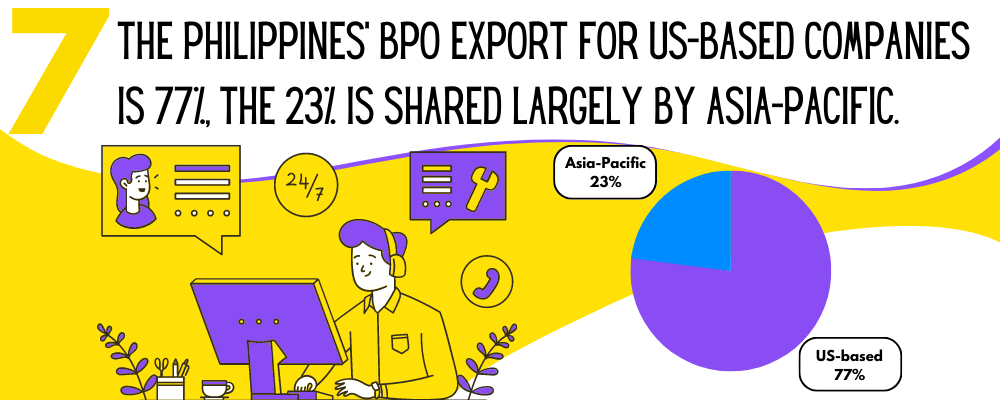
7. 77% of the Philippines’ BPO export is for US-based companies. The remaining 23% is shared largely by Asia-Pacific.
The IBPAP aims to craft a new roadmap for the industry beyond 2022, setting new goals and strategies to secure the leadership of the Philippine IT-BPO industry in the global offshoring space. According to IBPAP President and CEO Rey Untal, the 2028 roadmap is a longer-term cure with policies that reflect what the industry needs.
Following India, the Philippines is the second most prominent IT-BPM destination in Tholons top 100 list. IBPAP expects continued success as severe Covid-19 waves last year prompted clients to transfer business to the Philippines.
According to BSP Deputy Governor Diwa Guinigundo, BPOs tend to grow regardless of economic conditions. In an interview with the Contact Center Association of the Philippines (CCAP), he noted the following:
- If times are good, offshore companies need to outsource non-core services to remain competitive
- When their economies are not doing well, they have to resort to outsourcing because of the need to cut on costs.
The BPO industry is also locally dubbed “the sunshine industry,” and for a good reason.
Now the age of the digital economy has arrived, and more and more skilled freelancers and virtual assistants are contributing to the outsourcing industry.
Leading BPO companies in the Philippines:
- USource
- Concentrix
- Outsourced
- TaskUS
- Microsourcing
- Support Ninja
- Beepo
- Sourcefit
- Influx
- Teletech
- Alorica
- Teleperformance
- Bruntwork
- Wing Assistant
- Virtual Employee
- Upwork
- Acquire BPO
- Accenture
- Cognizant
- Sutherland Global Service
- ResultsCX
Over a million Filipinos employed by outsourcing firms
The Philippines continues to cement its position as one of the world’s leading destinations for business process outsourcing. While India remains the pioneer in offshoring, the Philippines has held the top global position in voice-based services since 2010 and remains a preferred choice for customer support, IT-BPM, and digital services. Despite global economic fluctuations and the disruptions brought by the pandemic, the country’s outsourcing sector has shown remarkable resilience, maintaining steady revenue growth and expanding its hybrid work capabilities.
With over a million Filipinos already employed in the industry—and more than a million additional jobs forecast in the near term—the BPO sector is now a major driver of national economic growth. Flexible talent, competitive costs, government support, and rapidly improving digital infrastructure continue to attract companies from the United States, Australia, Europe, and the broader Asia-Pacific. As the digital economy expands and demand for remote services accelerates, the Philippines remains firmly positioned as a reliable and scalable global outsourcing hub.
Outsourcing Questions
1. Why do companies choose the Philippines for outsourcing?
Businesses outsource to the Philippines because of its large, educated talent pool, cost efficiency, strong English proficiency, and long-standing experience in customer support and IT-BPM services. The country also offers solid infrastructure and government-backed incentives that support the industry’s continued growth.
2. Which countries outsource the most work to the Philippines?
The United States accounts for around 77% of the Philippines’ outsourcing exports. The remaining share is distributed across Australia, the United Kingdom and European markets.
3. What types of outsourcing services are growing in the Philippines?
While voice-based support remains strong, the Philippines is experiencing rapid growth in digital and knowledge-based services. These include IT support, software development, digital marketing, content services, data analytics, finance and accounting, and hybrid customer experience roles.
4. Is the BPO industry expected to keep growing?
Yes. Industry forecasts estimate revenues could exceed previous records, with the workforce projected to reach 2.5 million by 2028. Ongoing investments, expanding digital capabilities, and the rise of hybrid work arrangements continue to drive long-term growth.